Showing posts with label ARC. Show all posts

Saturday, 20 February 2016

Book Review: Tell the Wind and Fire

When I saw that there was an ARC for something by Sarah Rees Brennan possibly up for grabs - I had to request it. Honestly? I didn't even read the blurb. I liked the Daemon's Lexicon trilogy so so much
The Lady herself
(though didn't get on with the Lyndburn Legacy) that it was a must.

Tell the Wind and Fire is set in a New York that has been split into two cities: the light and the dark. The light have their own magic, and the dark's is much weaker, but the clinch is that when a light wizard uses a lot of magic, a dark magician is needed to drain their blood to stop them getting a sort of 'magic overload' as I think. This is the story of Lucie, born in the dark, child of the light, darling of the poster boy of the light who becomes, not entirely through her own choice in a historic battle between the two cities. There's witty humour, swords, pretty gems, secret hiding places, lies, plots and characters being unexpected. Ooh, and there's dopplegangers.

Now, I found out that this book is based on Dickens' A Tale of Two Cities, which I've read, and I had no idea. So, either: I have completely forgotten how that story goes, or this is a very loose adaptation. I can see the doppleganger idea with people looking alike and (wait for it...) the fact there are two cities. Please someone else enlighten me. To be fair, I haven't AToTT since I was about eight, so maybe I have just forgotten.

It was an enjoyable read. It did not remotely hit the spot of Dameon's Lexicon, nor was it as (in my opinion) poor as the Lyndburn series. It was told as first person from Lucie, but in a lot of ways I feel we still didn't really know here that well by the end. And we certainly didn't know any other character, bar Carywen. Makes sense because she's with him so much, but other characters are mentioned in a way that made me feel I should have the exact idea of who she's talking about, which is a little unnerving. 
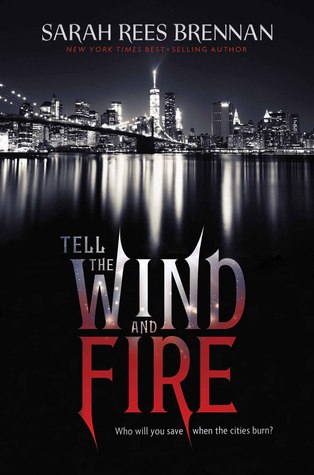
To be published in early April
Unfortunately, there was a lot of information (no 'show don't tell') when describing the world at the beginning. Now, I really don't know how fantasy/sci-fi writers get past this because readers do need to know a lot before any action begins. It works better in other novels: e.g. Daemon's Lexicon, as opposed to Cecelia Ahern's Flawed I recently read, where it was horribly stilted. This was somewhere in the middle - and I really wouldn't know how to get it right!

Towards the end, where Carywn has little speech out about him not being 'good' and how he is still 'selfish' and that Lucie 'treated him like a was a real person'... Didn't work for me. A little OoC and a lot too cheesy.

Basically- I enjoyed it! At the end, Brennan said it can be a stand alone from A Tale of Two Cities. But surely this isn't a stand-alone novel in itself. There must be sequels!

PS Does anyone know has Carwyn is supposed to pronounced?

Thursday, 19 June 2014

Tale of Two Very Different Books

I've been keeping up with all my ARCs from NetGalley, and it was also lucky enough to receive a paper copy of a novel directly from the author! Here are my (very different) thoughts on two novels.


The main thing I am thinking having just finished Deep Blue is 'phew!' At least I can stop reading it now.

I thought I'd like this book. A story about merpeople, a world under the sea (I love the sea) with a high fantasy sort of plot line. I wish I'd read some of the other reviews before requesting this ARC from NetGalley, because if I had then I needn't have wasted time reading it.

Maybe I'm being harsh, but it really just didn't work for me. There was a huge amount of information dumping at the beginning, which was clumsy but still left me unsure of all the particulars of Donnely's world. There is a glossary at the back, which may have come in handy but, as I was reading it in kindle format, I didn't realise this until the end. But, really, I don't think my overall opinion would have changed.

The characters were... about as limp as the plot. We end with six mermaids, but we picked four of them up near the end and, as such, have zero emotional attachment to them, and they aren't developed at all. I suppose they will be in the sequels but I for one am not going to read any more of this!

To top it off, there were some issues with incoherent point of view switching, and a lot of 'telling' rather than 'showing.' (Eg. She was eating too many sweets. She did that when she was nervous. Like now.) The writing style overall was nothing special, and I was very distracted by all of the lame puns, like currensea for money. It felt quite childish, even though it was a middle grade read.

I don't like giving bad reviews, but I have to be honest. It gets one star - purely because of the awesome front cover.

Please note I received an ARC from NetGalley, all thoughts and opinions are my own. Quotes may be changed by the final published edition, which was released on May 3rd.

And onto my second review...

I have, unfortunately, some experience of general hospitals in the UK and for anyone wondering, YES - this is exactly what they're like.

Brindle has even unflinchingly, ruthlessly honest about what life is like for the nurses on the 'front line.' I'd like to think it was exaggerated, or that he was bitter (Brindle is an RGN himself) but it's just not the case. It really is that hard.

An Angel's Alternative follows the story of three nurses, - John Hunter, Dave Chiltern and sister Ashe - one Health Care Assistant, - Roxane - and a patient, Tom, as well as snippets of other people's stories. Sound like too many characters? Confusing? It isn't because the characters are well-defined, and point of view remains consistent until some sort of break in the text. This may sound like a stupid comment, but there are many novels where point of view shifting I the middle of scenes creates real confusion and chaos for the book.

Plot wise, it fell down a little for me - things were all a little too rosy at the end, and, also, I felt like there was so much more to tell! This book could have been longer; I wanted it to be! Additionally, I would have liked a bit more depth to Sister Ashe's portion of the story, as well as Roxanne's. The male characters took the lead most of the way through.

Overall, a good book, an honest book, and one that might be enlightening to many people. Slightly different structure (it felt quite like a memoir rather than a novel) and a bit longer would be even better!

Please note: I was kindly given a free copy to review by the author. All thoughts and opinions are my own.

So, there we have it - two VERY contrasting books in terms of subject manner and whether I enjoyed them. I'd like to see what else Rick Brindle writes in the future, but I think I'll stay clear of Jennifer Donnelly...

Monday, 5 May 2014

Book Review: Second Star


Second Star

I'd been so looking forward to reading Second Star: a retelling of Peter Pan with a love triangle between Hook, Peter and Wendy? Count me in! Luckily, I wasn't disappointed. 

It started off positively, setting the scene and introducing characters: Wendy as our central protagonist, and her two younger brothers as the lost boys, missing presumed dead. The big thing for all the characters was surfing, not magic - the beautiful comparison between surfing on the waves and soaring through the skies, the vastness of the heavens and the depths of the ocean. I may not be a surfer but I love the sea, so this was intrinsically attractive to me. 

Wendy sets out looking for her lost brothers, but finds a lot more: Peter and his lost boys, are squatting in an old millionaire's mansion, with Jas (Hook) at the other side of the beach. The "evil" part of Hook? Jas is a drug dealer, selling "dust" to runaway teens and party animals. Jas and Peter used to be friends, surfing companions, before Jas turned and they swore to stay within their boundaries of the beach. Wendy's search starts with them, but who can she trust? Can she even trust her own experiences, or is the magical world of Kensington a figment of a drug-induced hallucination? 

The parallels between Second Star and Peter Pan are not, of course, perfect. Hook as a drug dealer and Peter as a surfer worked very well, but I felt uncomfortable with Belle, the character of Tinkerbell. I know that her jealousy features quite largely in Barrie's original, but it felt a little false here. Belle was the character I was most dubious about, although, oddly, I quite liked her. 

So, if you are looking for a very close re-envisioning of Peter Pan, you may be a little disappointed. If you're looking for a well written, very engaging book, then you'll be pleased. Personally, I love it - and would like to read more of Alyssa Sheinmel's books; her style is very soothing and lyrical to read.

But first, I went off to read the original Peter Pan! It's reminded me how much I loved it as a child, and I'm also keen to find some other modern day retellings of this much loved story. Anyone got any ideas?

Second Star will be released on May 13th 2014. I received a free copy of this ebook, but all thoughts and opinions are mine.

Monday, 3 March 2014

Book Reviews: Mad Governments and Missing Husbands

Riot by Sarah Mussi


Riot by Sarah Mussi

2018. That is what makes this book different.

There are a lot of dystopian YA books out there at the moment (believe me – I've read most of them!), but the majority are set in other similar world to our own, or our own world but further in the future. The unique thing about riot is we are only talking about four years time. AND it's in Britain – not America. That's terrifying; the events of Riot could really happen in the very near future. And that is precisely what makes it such fascinating reading.

Mussi tells the story through first person in the eyes of Tia, daughter of a key politician. Overpopulation has pushed the government into a highly unpopular bill called the “No More Children in Need Bill.” This means that people of the unemployed and uneducated classes will be “snipped” and therefore be sterile. Tia and thousands of others take to the streets and to the murky back alleys of the internet to undermine and overthrow the bill. But events spiral way beyond what Tia even thought possible...

Tia is an excellent central protagonist: she is likeable, gutsy and down-to-earth (although I got annoyed by how often she said 'frigging!') Both her and her key partner-in-crime character, Cobain, were very well portrayed and, as a reader, I cared about what happened to them. Never underestimate the power of likeable characters. Although the subject matter of the book is very heavy, there were lighter moments as well: banter and an evolving relationship between the pair alleviated what could otherwise have been a very dark story.

Chapter one throws you straight into the action: Tia is at a march where they chant “HANDS OFF OUR BODIES!”, telling the government that there is no way they will let this bill go forward. I was drawn straight in; unfortunately, Tia's thoughts were a little all over the place for the first chapter which meant it was a little confusing. I would have preferred the first chapter to be more clear and I also would have scrapped the prologue, which details someone having the “snip.” It was so much more exciting to be brought straight into the march.

Although Tia and Cobain were strong characters, I found Tia's father too much of an archetypal villain: he was predictable and a little unrealistic. Tia's mother also seemed to be the epitome of a stereotype (although a very different one) and I couldn't quite believe in either of them. This was unfortunate because such feisty people as Tia and Cobain need equal rivals. The only aspect of Tia's character that I felt dubious about was her fairly limited vocabulary; it made me doubt her reputation as a master hacker, as she sometimes came across as fairly simple. And, as I've mentioned, if I never hear the word “frigging” again, I'll be happy!

Overall, a really enjoyable book. I haven't come across Sarah Mussi before, but I'm on the lookout for her other books. I would recommend Riot to anyone into YA fiction, dystopia and contemporary politics; it is captivating and exhilarating.


And I know we should never judge a book by this, but the cover is awesome!

Note: I received a free e-book from Hodder Children's Books in exchange for an honest review. All opinions are my own.

You Should Have Known by Jean Hanff Korelitz


You Should Have Known by Jean Hanff Korelitz

'You Should Have Known' is the title of Korelitz's novel, and also the title of her central protagonist's self-help book in which she chastises women for choosing the wrong partners. It's an interesting premise; having a psychotherapist as the main character made me hope for insightful introspection and compelling contemplations on the nature of relationships.

It's difficult to say what I think of Korelitz's novel. At times it was compelling, but I also wanted to read it very fast at times – not due to its compelling nature, but because I just wanted to get through it. The first third or so was particularly tedious; it was very slow to get going. Korelitz's character Grace Reinhart Sachs actually reminded me of Bridget Jones at the start in a slightly alarming way. The likeness did not continue and the connection may have been entirely superficial (both lone mothers with children at very posh schools, and their interaction with other monied parents) but it struck an impression nonetheless.

After this very slow start, the real story starts. There is a crime, gradual realisations and an escape, before an entirely too-tidy-for-my-liking ending. There is no bang at the end; it's more like a little whimper.

I'm not sure what genre this book is. Although there is a murder, it doesn't feel like a thriller, but it's not 'fluffy' enough for women's fiction either. It strides the gap rather uncomfortably, uncertain of itself. I did enjoy it to a certain extent, but, as I said, I had to stop myself skimming some of the earlier sections and I was left dissatisfied with the ending.

One interesting thing to note (spoiler alert) is that we never meet Grace's husband, Jonathan. Now, we have plenty of opinions of him, plenty of knowledge and suppositions but we, as readers, never meet him. You scarcely notice this as the plot plays out and it was only at the end that I realised it entirely. I think this is very clever of Korelitz; to have such a key character that we never directly engage with is a very clever device. We never get any kind of real view of him, unbiased or otherwise. And, as Grace realises he is not the man that she married, this seems quite apt: she feels as blind as we do, left to make judgements based on someone we do not know.


Overall, I somewhat enjoyed it but it was rather unsatisfactory. Some major editing wouldn't go amiss for the beginning, and a stronger ending: these things would make me more enthusiastic. Promising – I may try some other books by Korelitz.

Note: I received a free copy of the e-book from Faber and Faber in return for an honest review. All opinions are my own.