Showing posts with label reviews. Show all posts

Friday, 1 December 2017

Review: No Time to Spare: Thinking About What Matters

No Time to Spare: Thinking About What Matters No Time to Spare: Thinking About What Matters by Ursula K. Le Guin
My rating: 5 of 5 stars

'No Time To Spare' is a compilation of blog posts written from Le Guin's blog between 2010 and 2016. I am not much of a non-fiction writer myself, but Le Guin is a particular favourite of mine, and I haven't read any non-fiction before so was eager to snap this up. I received a free copy from NetGalley; all thoughts and opinions are my own.

Perhaps if I had known that these were originally published on Le Guin's blog, I would have been less enthusiastic about reading this; however, not knowing I immediately wanted to read her words, and I'm glad I did. Reading these in a book format (albeit a ebook format - I would much rather have a physical copy) is very different to a blog. Le Guin herself touches on this in one her short writings ('A Note at the Beginning') where she was inspired by Jose Saramango's blogs (which, of course, I will now have to find some time to read.) I like her idea of a blog, borrowed from Saramango, where she doesn't have to constantly have a conversation below the post with readers. She can write something and that been the entirety of it. As someone who writes myself, I can understand the frightening nature of blogs - and I've grown up with them! (Maybe it's not a good thing that I can relate more to an octogenarian than someone like me in their twenties...)

Many of the extracts focus on ageing: what it feels like to be old, and the titular writing: 'In Your 'never had a job to retire from.' Writing is a calling, a thing of love, to be nurtured. What is this spare time? All her time is spent in doing something - whether it be writing a blog post, playing with her cat Pard, replying to her fan-mail (there's an enjoyable piece of writing on that; my advice is - don't really bother unless you're a small child and you aren't using a spell checker. That's the kind of fan-mail she enjoys the most), or staring into space. All her time is full. This way of looking at life is very kind; that is one thing that springs from these pages - Le Guin is kind. Not just in a grandmotherly, let's-look-out-for-the-children or even a Democrat we-need-to-do-something-to-sort-out-this-planet-and-this-gargantuam-mess-we've-got-into way. No, a simple pure kindness. It's something that can only be felt; in these very personal writings, Le Guin bears a little of her soul for us to see, and I am eternally enchanted.
Spare Time.' With wit, but with astonishing grace and humbleness, Le Guin explains that for her in her ninetieth years, there is no such thing as 'spare time.' And there never has been. She says she

Her writing about ageing is very moving. That's a very simple word - moving - but I cannot find a more suitable one, and perhaps should stop trying. In a writing of 2013 called 'The Diminished Thing' she addresses the American bent towards positive thinking. 'What's wrong with positive thinking?' you may ask. Well, Le Guin puts it very succinctly, very aptly. 'Encouragement by denial, however well-meaning, backfires... To tell me my old age doesn't exist is to tell me I don't exist. Erase my age, you erase my life - me.' What a way with words she has. She wishes to be respected as an 'elder' but she also encourages the respect of young people; both of which we appear to losing in modern day society.

Although some of her topics are vast, the way Le Guin writes is deeply personal. I feel like I 'know' her through these writings. This is, of course, nonsense, as Le Guin herself says when talking about receiving fan-mail. But she offers up her writings in a generous, unassuming way for us to take and do with what we will. Of course, I don't know Le Guin. I know some more about her life as it is now, I know quite a lot more about her cat, Pard (there's a lovely section dedicated to him called 'The Annals of Pard' and a very true-feeling writing about choosing a cat), but I do not know her. She is not my friend. Yet, the way she has written it is to make one feel as though you would like to be.

Other topics she covers include: the liberal use of two particular swear words that seem to have become a shortcut, but Le Guin unpicks them, their origins and their use - finding them to have more meaning than I think of when I read them in a novel. I will certainly think twice the next time I across either (which is most likely to be the next modern novel I read.) There's an interesting section 'debunking' narrative gift and its connection, or not, to literary quality, and its connection, or not, to good storytelling. I loved her piece about fantasy writing and the fear of unknown in 'It Doesn't Have to Be the Way It Is.' ('There really is nothing to fear in fantasy unless you are afraid of the freedom of uncertainty.'); her thoughts on utopia and dystopia ('Utopiyin, Utopiyang'); the way the President talks to the American people, about their worth and whether they were worthy of being asked difficult things ('Lying It All Away'), involving the first televised broadcast from the White House; the nature of growing up, muddled up with misquotations ('The Inner Child and the Nude Politician')... I could go on and on. I don't think there was a single writing here that didn't sing to me in some way. I want to go away and reread these short pieces and let them sit in my soul and speak to me.

One interesting thing I noticed was how surprised I was by how American Le Guin is; of course I shouldn't have been, but when we read the fiction of a fantasy/sci-fi writer it can transcend boundaries. So, rather stupidly, I was caught off guard by how American her 'natural' writing style is. She writes of 'The Great American Novel' and an author's quest for it (not something she has time for), and it isn't something I was really aware of; however, during reading this, I heard a programme on Radio 4 ('Open Book') which spoke to an American about that very subject. Eerie stuff. Le Guin's opinion on 'TGAN and TGOW' has changed over the last year (this piece was written in 2011) - from Huckleberry Finn (for all its faults) to The Grapes of Wrath (for all its faults) (Although she still dismisses the general idea: 'Art is not a horse race. Literature is not the Olympics.') And I, an ignorant English girl, have read neither (although works by the same authors). There were many occasions where I stopped and scribbled down a book I would like to read by way of her roundabout recommendation.


Most of all, I wanted to reread Le Guin's own books; the books where it all started, in my mind at
least (I'm not sure of the publication dates). The Wizard of Earthsea. Tehanu. All my well-loved
characters from childhood that deserve another visit. And they will get one. (Once I've finished the deluge of books I have to read to review...)

Despite knowing that fan-mail from adults that has correct punctuation and none of the charm that children's misspellings and mistakes, I do feel drawn to write to Le Guin now - hand-written, pen on paper writing. She has, for me, opened up her soul, and I crave to receive a tiny acknowledgement back. But - as she rightly says - this is not the job of the author; the author writes and the reader takes whatever meaning they want from it. 'Tell me what it means... That's not my job, honey. That's your job.' But I don't want to write and ask her what anything means. I want to write to her and feel that spark of human connection; the resonance that one feels with someone although I know it can never be reciprocal. (Although in my head, I can imagine discussing Hopkins' 'The Windhover' which she mentions in 'Readers' Questions', the sheer absurdity of proverbs mentioned in 'Having My Cake' (which also provided some information on Charles Darwin I didn't know), talking about Homer's The Iliad and The Odyssey...)

Still, 'No Time To Spare' has made me want to connect to Le Guin while - how do I say this delicately - while I still can. She has touched me in a way that non-fiction writers generally do not. I cannot rate this book more highly. For this small insight into such a great mind, we are truly blessed.

View all my reviews

Wednesday, 29 November 2017

Review: The Boy With One Name

Jones is the boy with one name, snatched as an infant from his loving parents by a Badlander called Maitland, he only longs to be a normal boy and have his family back. One night, he and Maitland are on patrol and come across an ogre 'moon-bathing.' Things don't go quite to plan; enter: Ruby, a foster child on the run, who is desperate to be part of the Badlander's world, despite its dangers and terrors. Along with a talking gun, a miniature fire breathing black dog, an old camper van, and a hefty sprinkling of magic - you're sure to be taken on one hell of a ride!


The Badlands are all around us. All the things that you've heard about in stories - witches, ghosts, ogres, giants, spells, curses - they're all real. It's just that most people don't see them. If you're a Badlander, however, it's all you see.

Jones is tired of the Badlands. He's tired of hunting down enemies for his master, constantly checking out every place he goes to in case of dangerous creatures, tired of living without a family. But he was rescued as a baby by his master, Maitland, who picked him up as a bundle left behind on some steps. He wasn't wanted. All Maitland wants him to do is to commence - the act that will make him a true Badlander, and be able to perform magic and spells that we can only dream of. But Jones? Jones wants to be normal. He's seen snippets of real life on the televisions of shop windows as they pass by; he's seen families strolling with their children; children going to school to learn maths and English, not about the Ordnung (the Badlander law) and what specific types of metal kill or repel different monsters. 

Wallis starts with what should be the biggest night of an apprentice's life: the night where they commence, and can perform proper magic. Maitland thinks he's ready (although his talking gun isn't too sure...) And Jones just doesn't know what to do. They've discovered an ogre moon-bathing, and Jones must make his first kill. Only, Jones knows this person as a man during daylight hours: he runs the sweet shop, and is perfectly kind. And, besides, he doesn't want anything to do with all this. But with Maitland being all he has, what can he do?

Enter Ruby, with a loud scream as she crashes her bike. This evening is really not going to plan. On the run from her foster parents, she's remarkably accepting of the situation when she gets past the 'thatsabloomingtrollogremonsterthingy!' When Ruby gets the measure of what's going on, all she can see is excitement. Being a Badlander sounds like the most awesome thing in the world. So what if the stupid Ordnung says that only boys can do magic. Girls can do everything boys can do, even better than boys in fact. Her mind's made up: Ruby Jenkins is going to be a Badlander.

The Badlands is a fantastic world that Wallis has created, hidden within our every day world. One could accuse it of being akin to Harry Potter (a magical world coexisting with the normal; some of the magical items are very similar e.g. 'Slap Dust' which has similar effects to 'Floo Powder' in Harry Potter), but they are in fact very different. This is pitched at a younger age group to Harry Potter and, as such, is a bit less serious and a lot of fun. Both the central characters, Ruby and Jones, are thoroughly likeable, and the other characters, even ones who play a minimal role, are well-rounded and thought out. There are no 'Mary Sues' here! 

I enjoyed Wallis' 'The Boy with One Name.' I could see it becoming a series; there's definitely potential, although I'm not sure what the plans are. I certainly hope to read more about Jones and Ruby and their 'new circumstances!' (I won't give anything away - no spoilers!)

A really good and fun urban fantasy novel for middle grade readers; I would definitely recommend it.

Further reading suggestions: The Magesterium Series by Cassandra Claire and Holly Black; Coraline by Neil Gaiman

I received this free copy from The Book Bag in return for an honest review. All thoughts and opinions are my own.

Saturday, 4 November 2017

Review: Neanderthal Opens The Door To The Universe

Neanderthal Opens The Door To The Universe Neanderthal Opens The Door To The Universe by Preston Norton
My rating: 2 of 5 stars

Here's the premise: Cliff Hubbard is a bit of a social retard. (Okay, that's probably not PC, but it's what kids would say). He's over six foot and, at 250 pounds is, hugely obese. His brother, also his best friend, has recently committed suicide; he lives in a trailer park; his father is an alcoholic; and he is teased constantly.

Basically, life's not very good.

Then, something strange happens. Aaron Zimmerman, massively cool jock who is one of Cliff's key tormentors - perhaps even the originator of his nickname 'Neanderthal' - has a boating accident. Everyone assumes he's going to die. Cliff has sort of mixed feelings about this: it's great he's no longer around, but he had been really determined to kick his butt, and if Aaron dies this sort of mucks up that plan.

But Aaron mucks up Cliff's plan further: he comes out of his coma, and talks to Cliff. An actual conversation, using his name, and being polite and everything. What is going on with the universe? Aaron claims he saw God and God gave him a list of things to do make Happy Valley High School suck less. Where does Cliff come in? God said that Aaron had to have Cliff as his side-kick. Cliff does get on board, suspiciously, but it seems like this magic list is doing more damage than good. Is Aaron just suffering from concussion? A logical conclusion, but, as the pair spend more time together, it's not something Cliff wants to believe. Surely, one person, just one, could like him for who he is without having sustained a massive brain injury.

Things sure get complicated...

I wanted to like this book; I really did. It sounded like fun - a quick read, a quick laugh, with the
Preston Norton
obligatory message that all YA books have these days. But... I just... didn't.

It's sort of hard to pinpoint why. One problem is it has a very slow start and I was getting pretty bored. But that wasn't all of it, obviously. The plot just didn't work. And I think the main problem was the characterisation, specifically, of Cliff. He's six foot and weighs 250 pounds. That's kind of the limit to his character. Okay, so there was a bit more character development than that, but really - for being such a ginormous size - he was a pretty flat character. And there's a relationship with a girl that really really doesn't work. It's unbelievable, out of character, unlikely, cringeworthy... just wrong.

I liked the references to '2001: A Space Odyssey.' That gets some points from me. But when the book tries to be all philosophical, I just got that squirmy feeling when someone's misjudged a situation and everyone feels all awkward. For example, Cliff's older brother said: "Life isn't just existing... It's a door. Don't you want to know what's on the other side? It just... well, it doesn't work. Not in this book.

I suppose I should give Norton some credit for the 'nod' to the LGBTQ community, but that's all it was: a nod. It didn't feel real. It felt like it was inserted into the book because that's what's 'in' in modern YA fiction at the moment, not because it meant anything to the author.

Like I said, I wanted to like it, and I persevered, but it was really disatisfying. By all means, go ahead and read it - I'd love to hear some positive reviews and maybe find out what I've missed, but - for me - this is a no.

Sorry Norton. Maybe I'll like your next book?

Thank you to NetGalley and Disney/Hyperion for the ARC copy to read. All thoughts and opinions are mine. This book will be released on May 22nd 2018.

Now this is definitely cooler. Crazy, but great. If you haven't watched it, you really should.


View all my reviews

Sunday, 3 September 2017

Review: Bad Ideas\Chemicals

Bad Ideas\Chemicals Bad Ideas\Chemicals by Lloyd Markham
My rating: 3 of 5 stars

This book has been likened to some cross over of the following books: A Clockwork Orange, Brave New World, Naked Lunch, Stand By Me and some others (not all in the same review.)

It’s not. Bad Ideas/Chemicals is a book totally defying categorisation.

Goregree is a half-finished project, discarded by its maker. Or stopped midway because of the unearthing of another settlement there before. Or a conglomeration of houses that somehow managed to become a place. Does it matter? No. The truth is: living in Goregree sucks.

It’s become a joke. The phrase ‘I’m not from round here,’ is passed around by all of its inhabitants. Because, even though some of them were actually born there, no one feels it belongs to them. No one wants it to belong to them. All it has going for it is a Star Trek themed bar, a constant supply of oddballs, and seemingly limitless supplies of GOTE.

GOTE is a ‘Bad Idea/Chemical.’ Made from foetuses whose mother’s have ingested poison from the ‘roaches’ (that look nothing like cockroaches) this drug takes you on highs that no other drug does. It
Lloyd Markham
affects your ‘temporoparetial junction’ (don’t worry - I had to look that one up too), and causes out of body experiences. Everyone’s hooked on it. Eventually, it kills you. Unless you kill yourself first.

Fittingly, the ‘best’ job that you can find in Goregree is working for ‘Mercy:’ the NHS’ privatised company that deals with assisted dying and euthanasia. Particularly fitting for Louie, one of the central protagonists, whose father is dying of alcoholism, and feels like checking himself into ‘Mercy.’ He’s not the only one…

The characters are all whacky, interesting and well drawn. Cassandra walks around in an orange spaceship; convinced she is an alien after seeing a film about ‘Alpha Centurai’ as a child. You’d think that would be weird. Not so much in Goregree. Here, anything goes.

This book is, at times, sardonically funny, but the humour is very black. But don’t take it merely as humour. This book is actually a very well drawn comment on society today: the neglect of social and mental health care, the effects of parenting, and the casual substance misuse that is rife in small towns. Markham isn’t afraid to write about big issues.

All in all, ‘Bad Ideas/Chemicals’ is a unique, warped and very thought-provoking read. One to read in an hour, then ponder over for ten times longer.

Thank you to Parthian Press for the chance to read this book; all thoughts and comments are my own.

View all my reviews

Monday, 21 August 2017

Review: The Goblins of Bellwater

The Goblins of Bellwater The Goblins of Bellwater by Molly Ringle
My rating: 4 of 5 stars

If you have Christina Rossetti's 'Goblin Market,' then you may have an idea of what to expect from this book. That isn't necessarily a bad thing; but it is something to note. If you haven't read 'Goblin Market' (I advise that you do), it's about a pair of sisters, one enthralled and seduced by the goblin's beautiful fruits, but then withers without them. Her sister saves her.

That, in a nutshell, is also the plot for 'The Goblins of Bellwater.'

Personally, I didn't mind knowing what was going to happen; I predicted (correctly) that it would stick to the general story arc of Rossetti's poem, but that was okay with me: there was plenty of other little twists and add-ons that kept it interesting. But if you want a book to surprise you - this isn't for you.

Skye and Livy live in Bellwater, a mostly unspoilt place, with little contact from their parents. Livy works as an 'eco-warrior,' which I really liked, as it resonated with me. Skye, meanwhile, works in a cafe whilst she tries to get her artwork noticed by an agent, someone, anyone! (Sound familiar to any other would-be authors or illustrators out there?) But, this is an updated, modern version of 'Goblin Market' - you've got to have your boys! Kit is what's called the 'goblin liaison;' a curse was placed on his family decades ago meaning he has to pay the goblins in gold each month. The goblin magic means he can steal from anyone, anywhere without the fear of being caught; it might sound fun, but
Arthur Rackham's original illustration for
Rossetti's 'Goblin Market'
Kit has a conscience, and detests his work. Historically, all the goblin liaisons have died young (goblins don't always play fair) and the curse falls to the closest relative, making the curse ever-lasting.

When Skye is seduced by the goblins, she's incapable of talking of anything that has happened to her, incapable, practically, of speaking, except in echoes. Livy, desperately worried about her, asks Kit's cousin Grady to come and spend some time with her, trying to get her open up, and providing her with good solid meals - Grady's spending time in Bellwater with Kit whilst he searches for a job as a chef. So, when the goblin magic compels Skye to choose a mate, she chooses Grady, and not a goblin.

This is not what the goblins had in mind.

But, boy, do they have some fun with it. Two humans ensnared by their curse? - it's just a bonus!

Kit gradually works out what has happened to Skye and, subsequently, Grady, and the plot really starts to kick off. The goblins won't bargain with him, and he knows better than to be tricked into another curse that could haunt his future family for centuries. So, it's up to Livy to sort it out.

I enjoyed 'The Goblins of Bellwater;' in fact, I enjoyed it a lot. Knowing the general story beforehand left me free to pick up on more of the nuances, and the ways in which Molly Ringle had tweaked and updated this Victorian story for our modern era. It's been a while since I've read some good modern fantasy (not quite 'urban' fantasy, as it's set in the wilds), and I thoroughly appreciated the ride. My favourite part was Livy's quest to save Skye. I won't go into details here - this is the part where Ringle veers from Rossetti the most - but it was great fun.

Molly Ringle
To be slightly picky, it all seemed a bit too neat, with all the loose ends wrapped up, but sometimes that can be okay. Sometimes I like a story that has a clear ending and we know where everyone stands. The descriptive passages were brilliant; Ringle has a real artists' eye when it comes to depicting the goblins and other fae. I was slightly unconvinced by Skye and Livy's relationship at times; I felt that Livy's character wasn't quite protective enough of her younger sister. But, these are minor points. It wasn't the most brilliant book I've read this year, but it was a lot of fun.

I've noticed that a lot of reviews state DNF (Did Not Finish), which surprised me. I think this may stem from the predictability of the plot, and, perhaps, the character of Skye who was, at times, one-dimensional. However, the reason she was one-dimensional is very clear: she's under a goblin spell. She literally cannot behave differently.

Start reading this with the knowledge that it's predictable and you'll be okay. If you want huge surprises, then this book isn't for you.

For me, it was great, particularly because of my love for the original Rosetti poem. I really need to read some more fantasy...

Thank you to Net Galley, Molly Ringle, and Central Avenue Publishing for giving me the chance to read this book. It will be released on the 1st of October.


EDITED TO ADD!! Here's a really interesting Q&A with Molly Ringle (thanks to the publishing team for allowing me access to this!) AND read on to the end for something even more exciting!

How closely did you follow Chris:na Rossetti’s poem “Goblin Market” as a basis for the story?
I call this a book “inspired by” Rossetti’s poem rather than saying it’s “based upon” it, because I did veer from the poem a significant amount. I first read the poem a few years ago, and it intrigued me deeply. It’s evocaAve and strange, and, like a fairy tale, has many symbols and events that could be interpreted as having several different meanings. My assignment to myself was to use it as a jumping-off point for a modern paranormal novel, which would then go its own way as the plot required. What I kept from the poem was the basic surface framework: we have a pair of sisters, grown but on the young side, one of whom becomes enchanted by eaAng goblin fruit in the forest and begins wasAng away as a result, alarming the other sister into seeking a way to save her. Since Rossetti’s poem ends with a fast-forward to the women being “wives” and telling their children about their adventures, and since I wanted to write a paranormal romance anyway, I gave my modern sister characters a pair of men to get involved with, in a double love story with eerie angles that I think match the eeriness of the original poem. Mind you, another interpretaAon of the poem is that the two women aren’t really sisters but lovers, which would be a different route to take and which I think would be lovely to see too!

For those of us who haven’t been there, what is Puget Sound like and why did you choose it as a se<ng for a retold fairy tale?

Puget Sound is a vast area of Pacific seawater, meandering into countless inlets and coves in skinny, deep Lords left behind by glaciers. SeaNle and Tacoma and Olympia lie on its shores, on some of its largest bays, but it also has many wilder and more rural shores, especially on the western side where it backs up against a huge naAonal forest on the Olympic Peninsula. That’s the region where my grandparents bought a vacation cabin decades ago, and where my family has been going for many vacations ever since. I can safely say it’s one of my favorite places on Earth. In order to agree, you have to enjoy a cool, rainy climate and all the thick moss and ferns and mushrooms and huge evergreens such a climate produces, and I happen to love those things. Fairy tales, at least those from Northern Europe, almost all involve a deep dark forest. That’s where the faeries, witches, werewolves, vampires, elves, and all the other interesting beings live. Everyone knows that. I haven’t spent much time in the forests of Europe (alas! I will someday), but I reckoned our Pacific Northwest deep dark forests were more than adequate for housing supernatural creatures. My grandmother used to tell us that the mossy ruins of big tree trunks in the Puget Sound forests were the homes of Teeny-Weenies, whom I always took to be faeries. So I set the story there, at the edge of the Sound, where saltwater meets woods and where the Teeny-Weenies live.

What is the significance of the four elements (Earth, Air, Fire, Water) in this story?
The four elements are common fixtures in many ancient cultures, and have remained popular into the modern day. One of my favorite TV shows is Avatar: the Last Airbender, which uses the four-element framework brilliantly in its world-building. In reading up on faery lore for this book, I found that scholars oMen classify types of fae under the four elements, and since that appealed to me, I did the same. As one of the characters in The Goblins of Bellwater muses, there’s something human and emotionally real about looking at nature that way, even if we technically know, thanks to science, that nature contains far more than four elements. And in my novel, the only way to break the goblin spells involves respecting and trusting each of the four elements, even when they’re at their most daunting.

Why do you think fairy tale and other myth and legend retellings are so popular right now?
I think they’ve always been popular! Maybe it’s a case of selection bias, because I personally have always been into ghost stories, fairy tales, and other supernatural lore, but it seems to me that human culture has never stopped telling such stories. As scholars of fairy tales will tell you, reading and writing about fantasy and the paranormal may look like escapism from reality, and sometimes I tell myself that’s what I’m doing, but in truth these stories end up giving us all the useful lessons about real life that any good stories do: empathy, courage, love, respect for nature and community, and the importance of thinking fancifully and creatively.

What are the goblins like in this book?
In keeping with both the “Goblin Market” poem and the bulk of faery lore, they are mischievous and villainous. They laugh a lot, but they are decidedly laughing at you, not with you. They steal, and in particular they lust after gold. Like other fae, they enjoy making deals with humans, but humans would be wise not to enter into such deals, as the obligation tends to be heavier than it sounds at the outset. These goblins go further than merely these, too; they assault and sometimes steal away humans and turn them into fellow goblins, and at other times enchant them into wandering unhappily in the woods until they waste away and die. Although the goblins are sometimes amusing in their level of witty rudeness, they are nearly all amoral and highly dangerous to get involved with. Only a scant few of them, who were once humans, manage to retain any human empathy. However, not all of the fae in my book are this cruel—the goblins are the worst of the lot! Others are willing to be quite helpful to humans as long as they are respected in return.

What kind of magic system does this book involve?
In this book, my main characters are ordinary humans who can’t do any magic, but they become involved in the dealings of the fae realm, which is a bit like another dimension. It can be entered or glimpsed by summoning the fae (which includes goblins), who might or might not answer you. But you’re luckier on the whole if they don’t, because many of them are treacherous, and the realm itself is a wilderness containing many uncanny dangers. From the point of view of the human characters, the magical rules and the cultural norms of the fae are nonsensical, almost inexplicable, but since some of these people have fallen under curses, they have to step in among those dangers and work with the rules as best as they can anyway.

What do you find most challenging in writing a novel?
At first, it’s usually getting to know the characters. I tend to start with a general idea of who they are, but then when I begin writing, I realize there’s too much I still don’t know about these people and therefore they aren’t coming across as real yet. It slows me down in the early stages while I take breaks to write notes in which I interview them and figure them out. I also have a perennial problem with writing antagonists. They have to do fairly awful things (being antagonists and all), but I still want them to feel like real people (or other beings), and therefore I have to get into their heads and figure out why they would feel justified in doing such a thing. It’s not a comfortable place for my mind to go. I suppose that’s why I gravitate more toward romance and lightheartedness: I much prefer spending time with those who love and laugh.

What are the easiest parts of wri:ng a novel for you?

No part of the process is exactly easy. But someAmes lines will occur to me seemingly out of nowhere when I’m writing, and they’re perfect for the moment; or I’ll find my characters talking to each other in my head when I’m not writing. And I love those moments, because for them to have come to life in my imagination like that, it means I must have done sufficient groundwork in figuring out the world and the characters. So although the groundwork is the hard part, it pays off and leads to easier parts later!

How did the writing of this novel, a fairly short stand-alone paranormal, compare to the writing of the Persephone trilogy?
It was far simpler! The Persephone’s Orchard trilogy had dual Amelines, for one thing: the ancient world in Greece, and the reincarnations of those people in the modern day. For another thing, it had far more characters, both in original and reincarnated versions. And for any series, you need to have plot arcs that stretch over the whole series as well as smaller ones that get wrapped up within each volume; and you have to keep the whole thing internally consistent in terms of mood and themes and character personalities. It turned out exhausting enough that I didn’t want to write another series again anytime soon. So I picked The Goblins of Bellwater as my follow-up project: small cast, straighaorward plot, and simple timeline. Most of the action takes place within about six weeks, in this small town, which is indeed a contrast to the millennia of world-spanning events covered in the trilogy!

Would you want to live in any of the fictional magical worlds you’ve created?
Strange though it might sound, I’d love to visit the Underworld as I wrote it in Persephone’s Orchard and its sequels. I made it much less scary, for the most part, than it is in traditional Greek mythology; and besides that, I love caves and glowing things, and definitely would be interested in a ride on a ghost horse as long as an immortal was keeping me safe during it. As for the fae realm we see in The Goblins of Bellwater, I’d like to catch glimpses of it, and of the fae themselves, but I wouldn’t want to actually enter the realm. Too perilous!

What are you writing next?
One of the genres I love, and haven’t written enough of myself, is male/male love stories, so I’ve been working on a couple of those. One is contemporary, no magic or supernatural stuff, and it’s undergoing the feedback-and-revision stage right now. Another will involve a fae realm like that of The Goblins of Bellwater, only in a new location in the world, a fictional setting I’m creating. I still have to figure out how this place works and what its magic system is like, in addition to getting to know the characters, but I’m excited about the idea and it has definitely taken root in my brain.

What are the most magical places you’ve been to in real life?
Puget Sound and its surrounding forests and mountains—which is why I chose the area for the enchanted lands in The Goblins of Bellwater. Also some of the forests and meadows in the Willameite Valley in Oregon, where I grew up. Oregon and Washington are both overflowing with natural beauty and I’m spoiled to have spent most of my life here. In addition, some places in Great Britain have felt quite magical to me, such as Tomnahurich (Hill of the Fairies) in Inverness, Scotland; or Old Town Edinburgh with its many close alleys and dark medieval buildings and brick-paved streets; or Westminster Abbey, not only because of its beauty and its many graves of astoundingly famous historical figures, but because when I first visited it as a 19-year-old, I’d never been in any building anywhere near that old before (having grown up in the Pacific Northwest), and it blew my mind. 


Wasn't that fun? I love that some of her inspiration comes from here in the UK, even though she's from across the pond; I'm also really excited to read some male/male romance - something I love but there isn't enough of (except in poorly written fan fiction...).

So, wanna have the really exciting bit now? There's a GIVEAWAY going on! For each of the four elements, there's a prize connecting to them; for more information and to enter, just follow this link:

https://www.rafflecopter.com/rafl/display/4e6fad2119/?

Good Luck!

View all my reviews

Wednesday, 10 May 2017

Bout of Books: Day Three


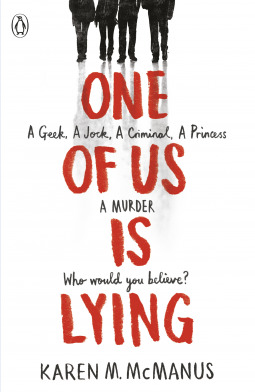
Books read: 1 (One of us is Lying)
Galley books read: 1
Reviews written: 2 :)
Pages Read: 367


Quite a full day's reading today, which is good because I know I'll have hardly any time tomorrow. I finished 'One of Us is Lying' which comes out soon. Right. Put it on order. It's that good. Loved it. You can read my review here or see for yourselves... (Don't worry, no proper spoilers, only things you find out in the first 50-60 pages)

And I wrote another review for a NetGalley book I read a while ago: 'Flight of a Starling.' Review here. So pretty pleased with myself today. Started on 'Eleanor Elephant is Not Fine' which comes out later this month; when I requested it from NetGalley, I didn't realise what a big release this was going to be! So far, very intriguing, but I'm annoyed I won't be able to have much time tomorrow.

How's everyone else doing? Remember, it's not a competition - I'm more proud of actually catching up on reviews than the reading!


Wednesday, 3 May 2017

Bout of Books 19

Wow! Is this really the first post of 2017? I believe it is! Well, this little blog never really had much of a life anyway, and it's just slowing wasting away... never mind!


I've decided to take part in 'Bout of Books' this time round. It's something I've thought about before, but never really got round to it/committed to it. I'm still not entirely sure about how it works, but there you go!

It's a week where you push yourself to read a little more than you usually do, and share it with other bloggers and Network it as much as you can! There's no competition between readers, everyone works at their own pace. It's just for fun. (Slightly wondering why I'm doing this, as I read every week anyway, but I think it'll be fun to link up with other people as well.)

There's a schedule for the week, which I don't quite understand, but here it is (it starts on 8th May) -

MONDAY - Introduce yourself insixwords
TUESDAY - Not a Font (??)
WEDNESDAY - Share your selfie
THURSDAY - Character dating profile (?)
FRIDAY - Rainbow book spine
SATURDAY - Seasons of Books
SUNDAY - FREE DAY!

I suppose I will find out in due course what some of these means.

People tend to set their own goals, and my key one is to READ MY GALLEY COPIES. I keep getting galleys from NetGalley and then I get distracted and read something else instead. So this means reading AND reviewing them, which means I'll get slightly less reading time, but it's something I desperately need to catch up on. So, there we are! See what happens!

Slight problem is I'll be away Friday-Saturday-Sunday, so I suppose I'll do scheduled posts for those, and then a round-up post when I get back (I think that's how it works!).

Wish me luck, to anyone who might stumble across this!

Oh, and thank you to the hosts for arranging this, it should be fun. (I think...)

UPDATED TO ADD: things have gone a little awry with a few much busier days than I expected so I'm still left with my last book to finish before reading all the Galleys... and it's War and Peace. I'm about 1000 pages in, but I still think it'll take me 2 days to read that, as you really need to concentrate! So, I'll get less of my galleys read but still up for the challenge!