Showing posts with label Mr B's reading spa. Show all posts

Monday, 24 October 2016

26 books: A Book with a Female Herione


This would have been number 13 in Bringing Up Burns 2015.

'Life after Life' by Kate Atkinson (A):
(read January 2015)

I really liked this book and I'm sure it will provoke tons of discussion as there is so much to remember and work out how it all fits together. I'm guessing that I will have missed nuances of connection that would become clearer with conversation with the book group.

It's a profoundly clever idea to write multiple versions of a life, muddle them all around and then
present them with the amazingly melodramatic yet evocative darkness falling at the end of each life . I think it illustrates how our lives are so random and what actually happens to us is just the culmination of a series of minor possibilities. It also makes life feel completely inconsequential in some ways: there was just a seconds difference between Ursula not being alive and her actually surviving so many times. Despite this very clever contrivance this device doesn't dominate the book. Often when authors get hold of a clever idea in terms of structure it's completely overwhelming and I didn't feel this was the case here. The human stories of these possibilities of people were very compelling and the description of life during the hardship of the wars seemed somehow very real. I loved the Hitler story as somehow being the best you could possibly do with your life in some way.I did wonder how conscious Ursula was of her lives. At the end this concept comes in in a more forceful way. I wondered whether any of the stories were then meant to be in any sense about real people or real things, and maybe we all create our own reality in our own terms.

All very interesting.


'The Miniaturist' by Jessie Burton (E):
(read July 2015)

I got this book from my Mr B's Reading Spa - thank you Mr B's and Emma!


In Burton's self-assured debut, The Miniaturist, we are swiftly introduced to Nella Oortman, and eighteen year old just married in Amsterdam. She is not greeted by her wealthy husband, Johannes Brandt, but instead finds the house with only his sister, the maid and a black man servant. When she finally meets Johannes, he is distant, and spends little time with her; his sister Marin is puritanical and disinterested with Nella, and there seem far too many secrets contained in this household. And that's without even mentioning her 3000 guilder wedding present: a cabinet-sized replica of their house...After a slightly rocky start – I didn't get into it as quickly as with many novels – this caught my attention. I liked Nella, I liked Cornelia, and I grew to like Marin, Otto (Toots), Hanna, Johannes, and most of the other characters in fact! I really wanted to know what was going to happen to them; the characters propelled the novel forward.
What could have been a rather banal story of a young bride in Amsterdam, struggling with her husband's 'defects' (I won't spoil it), was much more than this. I thought it was going to be a purely historical novel, but as the drama unfolded it became more than this. I loved the gradual nudging towards the supernatural. The cabinet, a seemingly patronising wedding gift, becomes central. The initial package from The Miniaturist seems fairly innocuous, but as each parcel arrives it seems more and more sinister. Or is it? Is the Miniaturist warning Nella, or is she the puppeteer pulling the strings?I loved this ambiguity. This was the stroke of real originality and intrigue in Burton's novel; what does it all mean? The gradual unfolding of Johanne's secrets, of Marin's (his sisters) secrets, the servants', The Miniaturist's... it's compelling almost in a horrific way. It isn't a horrible book; you don't go away with negative feelings, but it must be said that a lot of horrible acts are committed. It is haunting, as opposed to horrible. The historical side is very interesting as well as the supernatural: I learnt much more about trade in the seventeenth century, as well as a glimpse of prejudice and superstition on a personal level. I enjoy historical novels that do not ram facts down your throat; this is 'show don't tell' at its best.

There are flaws, of course. Of the three main mysteries, the first two could have been predicted. And the third is left untold... it's frustrating. It also suffers a little from being too gentle, and a lot of the potential emotional complexity isn't unravelled enough. We need to see the feelings, feel them with the characters. There were many points were I feel Burton had missed opportunities to further develop her writing, and the story.There are some lovely lines in the novel, including the notes from the mysterious Miniaturist, but I will leave you with what is, in my opinion, the most beautiful – and revealing – line:
'I love you. I love you. From back to front, I love you.'


J: Ancillary Justice by Ann Lecki
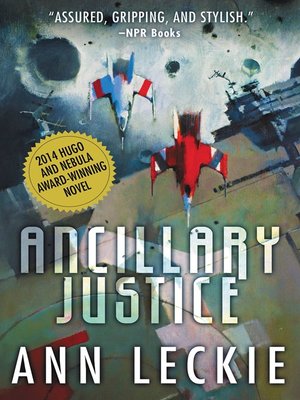

I haven't read a "spaceships and star troopers" type SciFi for a long while, and so was a bit doubtful when the wonderful Emma from Mr B's bookshop in Bath recommended this one. 

It is brilliant! Complex, with a slow revealing not just of the plot, but also of the world in which it is set. There are too many names, most of them unpronounceable, and that does slow my reading down. That's no different to reading Tolstoy or any other Russian and my policy for years has been to skim on past, refusing to worry who it is we are talking about now, as if this is a good author, I will find out quite soon enough. That works very will for Ann Leckie.

The two main devices, that of having all the characters female, and quite a few of them, including the principal, as not-human, is brilliant. One is left guessing what it means to be reading about the inner thoughts and motivations of women who are in very unusual roles for women in literature (a lot of it is quite violent and very active), and then to have the added layer that they may not really be human/single entities/biological at all. But then they are (human, that is), or perhaps more than human, in ways that matter.


Go, Ann Leckie! I hope the rest of your series follows this up as well. 

Thursday, 19 May 2016

26 Books: A Book Set Somewhere You've Always Wanted to Visit

This would have been number 10 in Bringing Up Burns 2015.

This was quite a hard one actually! I liked A's take on it best.


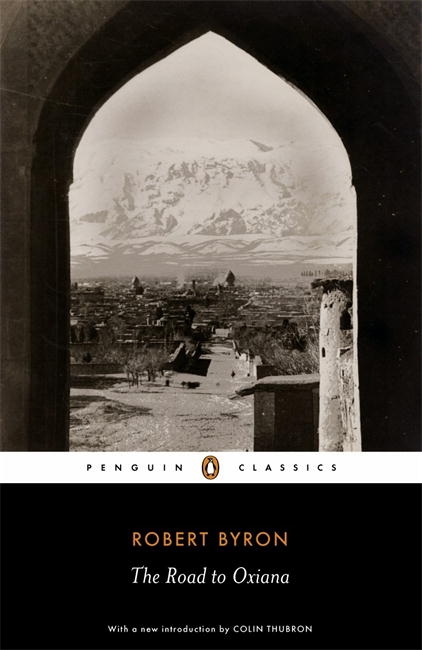
'The Road to Oxiana' by Robert Bryson
Just to make this totally clear, this is complete cheating because Joe read it in May 2016. He wanted it up here, and I told him it was last year's books, but he wouldn't take no for an answer. So, here it is, in wonderful cheating glory :)

This is a travel book, as the title suggests, and it is not by a relation of the 19th century poet of the same name, as both I and the person who gave it to me imagined. Robert Byron was a wealthy (Eton and Oxford) early 20th century man with no need to do anything to make his living, and having an interest in architecture inspired by his mother. He took it upon himself to find out about Islamic architecture, and in particular that of the very early flowering of highly decorative scripts (he usually refers to these as Sufic, so presumably inspired by people of the Sufi part of Islam?) made into the surfaces of mosques and tombs and memorial towers in the 11th and 12th centuries CE in Persia and Afghanistan. 

Getting into and getting about that part of the world then seems to have been as difficult in the 1930s as it it has been in much of recent times. There were the same political and administrative blocks to get past, the considerable risk of violence in Afghanistan, and also a lack of any surfaced roads between Damascus and Kabul. Much of the travelling was done in a Chevrolet truck, some on horseback and the rest in a series of cars which were regularly stuck in mud or sunk in rivers, which seem to frequently flash flood. Byron himself is very sanguine through all this, keeps his reading up (Proust and the like), and writes in great detail and with huge appreciation about each of the many mediaeval monuments he finds. I kept looking them up on google images, and his descriptions are accurate. Some, sadly, particularly in Afghanistan, have deteriorated in the last 80 years.

He also seems to have been a pretty decent linguist, at least in the language of Persia/Iran (Farsi, I guess) and reports many conversations verbatim, many of which are very entertaining. He was of course a man of his time, and freely uses race terminology in a way that is quite uncomfortable reading. My guess is that he was probably more liberal than many contemporaries though, as he doesn't go far out of his way to make negative comments based on race. He comes across very few women (how different would that be today, I wonder, and suspect not much different in Afghanistan at least) and occasionally comments on this. He is quite interested in current local politics, and dislikes the modernising intent of the then Shah of Iran/Persia, whom he refers to as Marjoribanks throughout, supposedly so that if his writings were found no one would realise he was being disrespectful. 

I have a prejudice against travel books, and this was a pleasant surprise, engaging, informative and fun. I finished it wanting to travel in that part of the world, though I guess that Afghanistan would be frightening and probably dangerous.


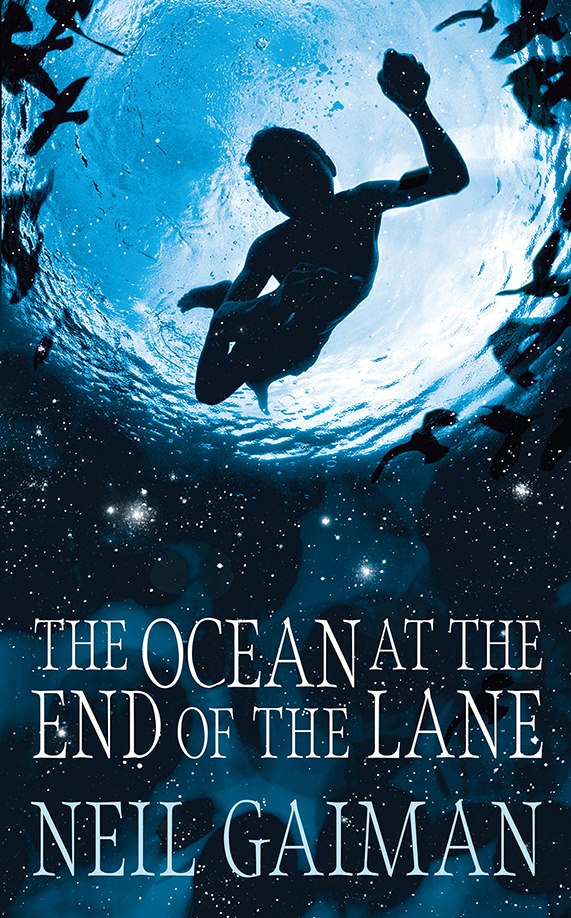
'The Ocean at the End of the Lane' by Neil Gaiman (A):

Where would you want to live but somewhere magical?


'Butterflies in November' by  (Translation) (E):

I have always wanted to visit Iceland. Well, that's a slight exaggeration of course. Since I've know what they are, I've always wanted to see the Aurora Borealis. So, any country where you can see them. But then I got into 'The Princess Diaries' by Meg Cabot (I was thirteen at the time, in my defence!), Mia had this obsession with Iceland. She had all kinds of cool facts about it: for example, that when the opera had a specific Russian opera visiting them (can't remember what it was), that ninety eight of the population went. Ninety eight! Mia figured this was because there was nothing to do. (I have no sources for the percentage and it may be complete bollocks.)

Anyway, my longing to visit Iceland grew and grew until it had to be the place I would visit. Sadly, I've never been. But My brother and DJ Lush (his partner) went and had a great time (although I'm not sure they packed well enough for the cold!), so I've been vicariously.

When I went to the wonderful Mr B's (again, I'm really) not being paid to advertise them, I had this list in mind, so I needed a book set in Iceland. I'd already read 'Burial Rites' (read it: amazing!), so I just asked them to find me something set in Iceland. A few minutes later and I had a choice! Brilliant service. This one looked quite fun, so I went for this. 

First of all, this book is first person, narrated by someone whose name isn't revealed. It's an odd way to write but there's always an authorial reason for it, usually because the character feels unnoticed. I don't this protagonist necessarily unnoticed, she just feels lacking in identity. We never learn her name. 

This is the story of a woman who, to be quite frank, has a crap day. She got dumped twice (her husband and her lover); she murdered a goose; and her best friend (-Perhaps a hint of something autobiographical) has been taken to hospital. She, agreeably, says she will look after him over the weekend. She promises herself a six week break, travelling around Iceland. But then the weekend turns into three months - the time her friend will be in hospital. And the trouble with Tumi... well, he's a lovely boy, but he's deaf-mute, only speaks minimal sign language (which she doesn't speak), he has to come with her on the trip (his mother is very blasé about it), and also he's incidentally been promised a pet. So, they have to find a pet than can travel, shattering Tumi's dreams of a horse. And one of the key reasons her husband broke up with her is she cannot deal with the idea of children.

It's really not going well.

It's a real mix, this book. It's very funny in places. The people she mets upon the way are often laughable, to the point of being caricatures. In this zany book where 'nothing is as it should be any more' and butterflies are flying in November, there a lots of powerful moments. Yes, it great fun when she wins two lottery tickets and they splurge out on fun things; it's cool (literally!) when they go swimming in the icy waters of Icelandic lakes; the contrast between her life in Reykjavík and the countryside.


But there are serious issues here: what does it mean to be a mother? What really makes a marriage? (Her husband says that it does not include '[coming home] On Tuesday [and] you've cooked a four-course meal on a total whim, a Christmas dinner in October.') What importance is your job; how much does it affect your quality of life? (That's an interesting one - the author works partially as a translator, and that is the character's mine job.) And there are the flashbacks to her childhood, which are very touching.

Overall, though, it is an quirky fun book at heart. It's quite simply, and somewhat touching. It ends with 'Forty-Seven Cooking Recipes and One Knitting Recipe.' There's a word of caution in there -
'certain of these dishes may work better on the page than on a plate...' Prime example" 'Undrinkable Coffee.' Hmmm.

She goes to a medium at the beginning of the novel, who gives her these words of advice:

"...it's all threes here. Three men own your life over a distance of 3000 km, three dead animals, three minor accidents... animals will be maimed, but the men and women will survive. However, it is clear that three animals will die before you meet the man of your life... and it would be good to buy lottery tickets... two..."

And it all seems pretty apposite...


I'll stop going on; I seem to have much more to say than I thought!  Sorry for such a long review. And even despite the rain and the cold and the desolateness, I still definitely want to go Iceland. One day.

And, as always, thanks to Mr B's, and a shout out to Brian Fitzgerald, as translators are always underrated.

xx

Saturday, 27 June 2015

In Praise of Mr B's


As some of you may know, today marks the end of Independent Booksellers Week. It's great to see support for independent shops, as so many people (I'm guilty too!) will opt for the easiest way out, and just buy something from Amazon. And even in terms of bookshops, Waterstones and Blackwells have a pretty good monopoly of the market...

HOWEVER. The independent booksellers are biting back! There may not be thousands of them, but I'm sure you'll agree with me that there is absolutely nothing like a small bookshop. The level of service, the intimate feeling of being with books, the personal recommendations, that feeling you get that you're in on a wonderful secret...

Well, I'll share my 'secret.'

I've talked plenty about Mr B's already, but I just want to sing their praises again. They are a wonderful independent bookshop in Wells, tucked away but quite near the centre. It's deceptively big! There are just so many books inside! Two stories, floor to wall with books. I have done a Reading Year with Mr B's (see all my reviews!), and I did a Reading Spa this year. I am slowly-slowly making my way through these books - I'm eking them out as much as my patience will allow me too, as the thought of not having them is too painful to consider!


A Reading Spa means paying to have a 'bibliotherapist' sit down and talk to you (tea and cake available!) for half and hour or so, and then they go off and find books they'll think you'll like. It's magical! And a Reading Year is most definitely the best present I have ever had. You get to know your bibliotherapist, and then they will send you - beautifully hand wrapped in brown paper and string, with Mr B's seal - a book through the post every month. It is so exciting!


My bibliotherapist is Emma, and she has been fantastic. We've continued to correspond intermittently, and it's just amazing to have someone in tune with my reading tastes.

Mr B's also host talks and signings from authors!! I haven't been lucky enough to go to one, but they have sounded exciting; they're even going to have Louis de Berniere later in the summer, as well as Justin Cartwright! So, some really big names.

Here is a little Q&A from Emma, the best bibliotherapist out there!

How long have you been working with Mr B's? Just over two years now!

What's the best thing about working there? Getting to talk about books all day and meeting such wonderful book-loving people. I particularly love being a ‘bibliotherapist’ and doing the Reading Spas with people, or choosing books each month to post out to people as part of the Mr B’s Reading Year. Both are great ways of introducing people to books and authors they may never have come across before.


What books are you looking forward to this summer? So many and it’s hard to narrow it down. I will cherry-pick a few for you: ‘The Last Pilot’ by Benjamin Johncock, ‘The Seed Collector’s by Scarlett Thomas, ‘A Little Life’ by Hanya Yanagihara, and of course ‘Three Moments of an Explosion’ by China Mieville!

Top 5 books of the year so far? Oooo…again there have been quite a few already! In no particular order: ‘The Honours’ by Tim Clare, ‘The Gracekeepers’ by Kirsty Logan, ‘Villa America’ by Liza Klaussmann, ‘The Buried Giant’ by Kazuo Ishiguro, and ‘Weathering’ by Lucy Wood.  

I would just like to celebrate Mr B's and all other bookshops like them. (Particularly them. But I'm biased.) Think about where you shop.

(I wasn't asked to write this post - I did it spontaneously because I love them so much!)

Some of my favourite Mr B's books:
Prep by Curtis Sittenfield
The Bone Season by Samantha Shannon 
Burial Rites by Hannah Kent <= Best one!