Showing posts with label 26 books challenge 2015. Show all posts

Thursday, 3 November 2016

26 Books: A Book that Everyone Else Has Read

(finally another 26 books! Enjoy)


This would have been number 20 in Bringing Up Burns 2015


Catch 22 by Joseph Heller
(read April 2015)

Well I probably missed the point. I chose Catch 22 as one of my '26 books to read in 2015' and it was the ' book from my shelves that I haven't read' until I realised I don't have it (where did it go; whose shelves am I familiar with seeing it on?) so I got a very cheap Kindle edition (notable for its typos). I read about a hundred pages, and then decided that my life's too short to waste on something I just didn't want to come back to. Reading is for fun (in some sense, it can be gruelling, but if I don't want to know what happened
next or am annoyed and after a good chunk of the book this hasn't worn off, then STOP!).

A little rant.

Back to the book.

I think I understood that it is highly ironic. Every sentence is tortuous and contradictory. It illustrates the life of members of a USAF bomber group in 1944/5 Italy, and the essential conundrum of their lives, which is that they all don't want to be there, they don't want to continue to risk their lives, they are waiting to serve their time and go home, and the central character is trying to get out of further bombing missions by pretending to be 'crazy' but this doesn't work: If you are willing to fly missions, you are crazy. If you don't want to fly missions you are not crazy because that's common sense. You would get signed off having to fly if you are crazy but to declare yourself crazy is self cancelling (see beginning of sentence). This is Catch 22.

Last year I read Evelyn Waugh's Sword of Honour trilogy. It's about the same period, it has a similarly cynical attitude to war and to WW2 in particular, which is especially interesting because this is the war that is generally given as being sainted, almost a holy war because the Nazis were so evil, and because of the holocaust. What we all miss in that long after the event interpretation, is that this was accidental. WW2 was actually just like most other European wars, about territory and alliances. Yes the Nazis were spectacularly horrible in a way that Western civilIsation needs to continue to learn from, but that wasn't why Britain and the US fought them. So it's interesting to read contemporary accounts that weren't pro-establishment. I found Evelyn Waugh much more interesting (if a little turgid) than Heller's really dated comedy method. It was just tedious!
Sorry!

J

'The Other Boleyn Girl' by Phillipa Gregory (E):
(read January 2015)

** spoiler alert **
 Now, I really really enjoyed 'The Other Boleyn Girl,' but I feel curiously guilty for doing so.

Let's examine this. I feel like I shouldn't enjoy Gregory's books because you often hear about the plethora of historical inaccuracies that she has, and that she writes the 'worst type of historical fiction.' Almost like soaps or something, but just set in a different era. I have mostly steered clear of her books after reading 'A Respectable Trade,' which I thought was abysmally written, and I really didn't enjoy.

This? Loved it.

There was, as others have criticised, a tendency towards one dimensional characters - but not entirely. Many characters had a singular predominant trait - Anne was ruthless and ambitious, Henry was arrogant and hedonistic, singularly fixated on producing a male heir - but they had other traits too, and their prevailing traits were very understandable. Mary Boleyn herself was not, as others have suggested, presented as an innocent amongst the debauched immorality of the court; she was fickle and inconstant from the start.

It was very compelling. Strange to read a book where you know the outcome, and yet can't put it down because you want to know what happens!

In the interests of looking at this fairly, I decided to try and discover what the actual historical inaccuracies were. This is what I have managed to find by trawling the internet.

1) There is no proof of incest between George and Anne Boleyn, where it is heavily implied in the novel.
There is no proof of George Boleyn's homosexuality. There is no proof as to the paternity of Mary Boleyn's children, although it is speculated that one or more may have been fathered by the king. These, to me, are not an inaccuracies - it is building on something that may have been truth. At the end of the day, this is a novel, not a history book.

Philippa Gregory herself!
2) Mary Boleyn was generally thought to be the eldest of the three siblings. I'm curious as to why Gregory decided to change this, because the dynamic between the three of them would have been significantly different if she had been the elder. This inaccuracy is the most curious to me - why? And the plot does hinge rather on Mary being the youngest. Maybe Gregory should have stuck to the generally perceived facts and we would have had a very different novel.

3) Anne Boleyn takes Henry (Mary's son) on as a ward when his father William Carey dies of sweating sickness, rather than much later as in the novel.

4) Mary Boleyn in the novel is sexually inexperienced before she beds Henry VIII, but it is thought that her time in the French court had her reputation sealed as very promiscuous. This is argued between scholars, so who knows?

5) And, of course, the characterisation of Anne Boleyn herself. She is portrayed as pretty ruthless and cruel in the novel, although not wholly so, whereas many historians believe her to have been a sweet girl. Who knows? This is an alternative perspective, and, truthfully, we will never know what she was like.

To me, these inaccuracies are not enough to take away from the enjoyment of the book. If some say it is trashy historical fiction - so what? I enjoyed it, and would recommend it to anyone who likes historical books. I'd like to read more of Phillipa Gregory, now that I can forgive her for 'A Respectable Trade.'

E

Friday, 28 October 2016

26 Books: A Book By An Author You Love

This would have ben number 7 for Bringing up Burns.


'Flight Behaviour' by Barbara Kingsolver (J):
(read February 2015)
I'm writing this review some time after I read Flight Behaviour, and I am a little surprised that I gave it full marks, as I think it is less good than The Poisonwood Bible. And that may be, as I find often the case with an author that I love, that if they are consistent, what is exciting and wonderful about the way they write the first time, is less exciting with repetition.


That said, I read Flight Behaviour twice, once several years ago, and more recently when it came up in our book club, and I found myself defending it against those who saw it as mainly for the purpose

of proselytising Kingsolver's ecological message. So what? (unless one doesn't agree with that message about the danger of climate change, or unless her story doesn't work because she bends it to this purpose).

It's a VERY good story, with well drawn characters, living out their believable lives with real human families and their impossible difficulties, and at the same time living through a small scale environmental catastrophe (or is it: read to find out).


Once again, some of Kingsolver's characters are strongly motivated by Bible Christianity, and some of the others find this behaviour objectionable. Some of these Christians are rigid and mean, and others aren't. Does Kingsolver herself have these issues in her immediate family, or is modern America so full of this type of Christianity that it's always relevant?
The only thing missing from this book that I appreciated about The Poisonwood Bible is that element of understanding a piece of history. There is nothing about fairly recent West Virginia (or wherever it's set, somewhere near there I think) that I now feel enriched for understanding.


War Horse by Michael Morpurgo (E):
 I really love Michael Morpurgo; he was such a beloved author of mine as a child. I lapped up his books, particularly the ones set in the Scilly Isles that are so familiar to me. Since War Horse is now his most famous book and I hadn't read it (it came out after I was a bit older) I really felt I needed to read it. I'd love to see the stage production (I think it's still on, though not at the National anymore), as the feedback from that has been phenomenal. 

Anyway, onto the book.

Actually, I was really disappointed. It's hard to say this because: 1) I love Michael Morpurgo; and 2) it's difficult to go against public opinion. Everyone loves War Horse (well, I'm sure it's not everyone), but it just didn't work for me. There were too many fast changing characters, so as each one was passed by (or had passed on), there hadn't been enough time to become emotionally attached to them. I felt like: 'oh, that's another one.' It was a stream of drudgery through WWI with each character (apart from Joey) making a brief exit and entrance. There weren't really any other main characters, except from Albert but he didn't have all that much 'screen time' because the middle of the book was centred elsewhere.

I'm disappointed. I wonder if this is something that has come with age; maybe Morpurgo's other books are like this as well, but it didn't feel so when I was younger? Maybe I've read so much in the intervening time that this style just isn't emotionally engaging enough anymore. I don't dare to read my old favourites. I'd still like to see the stage play, but not in such a burning desire sort of way anymore.

It's sad, but maybe, Michael, I've just grown out of you. I miss you.

Monday, 24 October 2016

26 books: A Book with a Female Herione


This would have been number 13 in Bringing Up Burns 2015.

'Life after Life' by Kate Atkinson (A):
(read January 2015)

I really liked this book and I'm sure it will provoke tons of discussion as there is so much to remember and work out how it all fits together. I'm guessing that I will have missed nuances of connection that would become clearer with conversation with the book group.

It's a profoundly clever idea to write multiple versions of a life, muddle them all around and then
present them with the amazingly melodramatic yet evocative darkness falling at the end of each life . I think it illustrates how our lives are so random and what actually happens to us is just the culmination of a series of minor possibilities. It also makes life feel completely inconsequential in some ways: there was just a seconds difference between Ursula not being alive and her actually surviving so many times. Despite this very clever contrivance this device doesn't dominate the book. Often when authors get hold of a clever idea in terms of structure it's completely overwhelming and I didn't feel this was the case here. The human stories of these possibilities of people were very compelling and the description of life during the hardship of the wars seemed somehow very real. I loved the Hitler story as somehow being the best you could possibly do with your life in some way.I did wonder how conscious Ursula was of her lives. At the end this concept comes in in a more forceful way. I wondered whether any of the stories were then meant to be in any sense about real people or real things, and maybe we all create our own reality in our own terms.

All very interesting.


'The Miniaturist' by Jessie Burton (E):
(read July 2015)

I got this book from my Mr B's Reading Spa - thank you Mr B's and Emma!


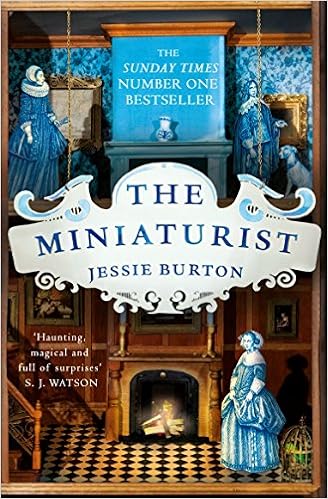
In Burton's self-assured debut, The Miniaturist, we are swiftly introduced to Nella Oortman, and eighteen year old just married in Amsterdam. She is not greeted by her wealthy husband, Johannes Brandt, but instead finds the house with only his sister, the maid and a black man servant. When she finally meets Johannes, he is distant, and spends little time with her; his sister Marin is puritanical and disinterested with Nella, and there seem far too many secrets contained in this household. And that's without even mentioning her 3000 guilder wedding present: a cabinet-sized replica of their house...After a slightly rocky start – I didn't get into it as quickly as with many novels – this caught my attention. I liked Nella, I liked Cornelia, and I grew to like Marin, Otto (Toots), Hanna, Johannes, and most of the other characters in fact! I really wanted to know what was going to happen to them; the characters propelled the novel forward.
What could have been a rather banal story of a young bride in Amsterdam, struggling with her husband's 'defects' (I won't spoil it), was much more than this. I thought it was going to be a purely historical novel, but as the drama unfolded it became more than this. I loved the gradual nudging towards the supernatural. The cabinet, a seemingly patronising wedding gift, becomes central. The initial package from The Miniaturist seems fairly innocuous, but as each parcel arrives it seems more and more sinister. Or is it? Is the Miniaturist warning Nella, or is she the puppeteer pulling the strings?I loved this ambiguity. This was the stroke of real originality and intrigue in Burton's novel; what does it all mean? The gradual unfolding of Johanne's secrets, of Marin's (his sisters) secrets, the servants', The Miniaturist's... it's compelling almost in a horrific way. It isn't a horrible book; you don't go away with negative feelings, but it must be said that a lot of horrible acts are committed. It is haunting, as opposed to horrible. The historical side is very interesting as well as the supernatural: I learnt much more about trade in the seventeenth century, as well as a glimpse of prejudice and superstition on a personal level. I enjoy historical novels that do not ram facts down your throat; this is 'show don't tell' at its best.

There are flaws, of course. Of the three main mysteries, the first two could have been predicted. And the third is left untold... it's frustrating. It also suffers a little from being too gentle, and a lot of the potential emotional complexity isn't unravelled enough. We need to see the feelings, feel them with the characters. There were many points were I feel Burton had missed opportunities to further develop her writing, and the story.There are some lovely lines in the novel, including the notes from the mysterious Miniaturist, but I will leave you with what is, in my opinion, the most beautiful – and revealing – line:
'I love you. I love you. From back to front, I love you.'


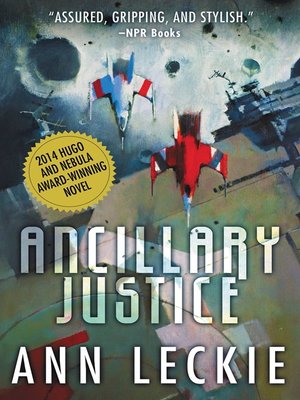
J: Ancillary Justice by Ann Lecki


I haven't read a "spaceships and star troopers" type SciFi for a long while, and so was a bit doubtful when the wonderful Emma from Mr B's bookshop in Bath recommended this one. 

It is brilliant! Complex, with a slow revealing not just of the plot, but also of the world in which it is set. There are too many names, most of them unpronounceable, and that does slow my reading down. That's no different to reading Tolstoy or any other Russian and my policy for years has been to skim on past, refusing to worry who it is we are talking about now, as if this is a good author, I will find out quite soon enough. That works very will for Ann Leckie.

The two main devices, that of having all the characters female, and quite a few of them, including the principal, as not-human, is brilliant. One is left guessing what it means to be reading about the inner thoughts and motivations of women who are in very unusual roles for women in literature (a lot of it is quite violent and very active), and then to have the added layer that they may not really be human/single entities/biological at all. But then they are (human, that is), or perhaps more than human, in ways that matter.


Go, Ann Leckie! I hope the rest of your series follows this up as well. 

Saturday, 15 October 2016

26 Books: A Book with a Colour in the Title

So, keeping up with the 26 books challenge! If only we'd actually posted this during the year is was aimed at... It means no one's interested as they're all doing 26 Books 2016. Sad times :( Anyway, here it is:
A Book with a COLOUR in the Title!

This would have number 9 in Bringing Up Burns Challenge 2015.


'Fried Green Tomatoes at the Whistlestop Cafe' by Fannie Flagg (E): Well, I had written a nice review for 'A Spool of Blue Thread,' but it felt like we needed some variety. So I sought out another 'colour' book (I hadn't happened to read any others), and decided on a real classic.

I'd never really heard anything about this book apart from the name, the fact it was set in the US, and that I thought it had been into a film. So, it was quite exciting to read a book I knew so little about! own mother in an people's home - this is Evelyn's escape from her Mother in law! Mrs Threadgoode's story is much more exhilarating - the tale of tomboy Idgie and her friend Ruth who ran a cafe that sold (you guessed it) damn good fried green tomatoes. (I'd never come across them before. Are they a purely American thing?)
It's the story of Mrs Threadgoode telling her life story to Evelyn, the wife of someone visiting his

People seem to be highly interested in the question of 'were Ruth and Idgie lesbians?' I really think it doesn't matter. They were truly good friends, and that's all we know. It's all I assumed really, living back in the 1950s.

It's an easy read, although it took me a long time, because I couldn't really get into it. The intertwining relationships left me a bit cold if I'm honest. I was actually more interested in the 1980s story of Mrs Threadgoode (Ninny) and Evelyn - the way that the telling and listening to of the story changed both their lives. Evelyn has a brief release from her depressed slump, and that made me feel something. That was life affirming.

Overall, it was disappointing, I hate to dislike classic classics and go against popular opinion, but it wasn't for me. I'm not saying it was a bad book, I just wasn't enthralled. Maybe it would appeal more with a British setting, so I felt more of a connection. A lot of the references were American, and made little sense to me. I feel I've let the author down by not enjoying it and, perhaps, by being not open enough to American 50s culture? Not good, E, not good.


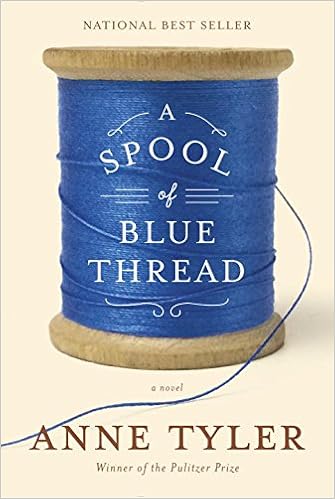
'A Spool of Blue Thread' by Anne Tyler (J): I think this was a perfect book. I know that is the general opinion, but never mind. I had some of the same feelings as I did when reading The Goldfinch last year, that is: I am in safe hands here. This author knows what she is doing and I trust her entirely to lead me in a way that will be entirely satisfactory. 

And I find it particularly interesting that these two books by top-of-their-form American women should both conjure up this feeling, as their subject matter is antithetical to each other. Donna Tart writes about people who are leading lives and having experiences that no-one I know is, and often I ask myself as I'm reading, "Has DT herself taken that many drugs or spent that much of her life drunk to be able to write about that experience?". Anne Tyler on the other hand writes about families doing the things that all families do: everyone I know has these lives (normal on the surface, tortured underneath, but it's not really torture, it's just life). And both are compelling. Is it cleverer to make ordinary life compelling?
It doesn't matter. What I like best is the writing, the use of words.
Thank you Anne T.

A also read 'A Spool of Thread' and, likewise, really enjoyed it. 

'til next time! x

Tuesday, 11 October 2016

26 Books: A Book with a Blue Cover

This would have been number 18 for Bringing Up Burns 2015.

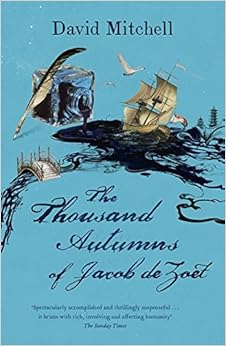
'The Thousand Autumns of Jacob de Zoet' by David Mitchell (J):
(read March 2015)


What an excellent book! All the right elements for me:
-compelling story
-characters I wanted to know about
-very good use of language, which only occasionally tipped over into self-indulgence, and when, towards the end, in my opinion it did with a paragraph that was in fact a rhyming list-poem for no reason, I was feeling indulgent. In fact as I write this, I am wondering if David Mitchell's knowledge of Japanese culture gives him a context that makes a rhyming list appropriate.
-information. I like finding out more about the world, and especially the historical world, and now I know more about the Japanese-Dutch relationship during the Shogun period of isolation. I have checked it out on the Netherlands embassy website, and it confirms the happening in the novel in some detail.

So: congratulations David Mitchell, may many more read this wonderful novel! I might even return to Cloud Atlas, which I gave up on some time ago, for reasons I don't recall.

J

What We Left Behind by Robin Talley

I don't usually go for romance novels, as they all seem a bit too... girly for me? Well, that's certainly bad terminology when reviewing this book.

What We Left Behind is the story of Gretchen and Toni/y, girlfriends, moving into college and discovering their identities to do with sexuality and gender. That's it in a nut-shell. It was really refreshing to see a young adult novel about transgender or gender queer people, rather than just gay people. Not that I'm opposed to LGB books - not at all! Just that this was something a bit more original.

It really made me think a lot more about the nuances of things - I've never thought about the use of pronouns particularly, or the difference between gender queer, gender nonconforming, non binary etc. Toni/y is struggling with all of these things throughout the novel. I liked the way that each chapter alternated the perspective (Toni-Gretchen-Toni-Gretchen), but, unfortunately, Toni was a much more dominant character. Until the end, Gretchen is fairly passive and a sort of vessel for Toni's continued rumination on her problem of labelling. She came into her own a bit by the end, but it was still much more Toni's than Gretchen's story.

Talley captured, I think, the confusion of indecision and identity very well. As a window in to what some people's lives can be like, I think this is a valuable book. But, because of the nature of a lot of the circularity of her ruminations, the book felt like it was also perambulating and repeating itself a lot. Sometimes perfect portrayal of a feeling or experience doesn't actually make for the most scintillating reading. Maybe some more editing wouldn't have gone astray?

Basically, I liked the premise, the story, and sort-of liked the characters, but I felt the writing let it down. It was fantastic and fascinating, though, to have some small insight into this world.

I received an ARC from NetGalley in return for an honest review, but all thoughts and opinions are my own.


'The Miniaturist' by Jessie Burton (A): 
(read May 2015)


This is the story of Nella, set in 1600s Amsterdam and her marriage to a merchant, woven with his odd household involving a black servant and his domineering sister Marie. It's very evocative of place with sounds/smells etc but an odd story with a mystic miniaturist model maker making a kind of 'real dolls' house.' Sad and tragic, but not ultimately depressing. An okay read.

Saturday, 4 June 2016

26 Books: A Book Set in The Summer

This would have number 14 in Bringing Up Burns 2015

Right time of year! Just E this time.

This was a hard one to find - most books change seasons. Actually, that's not true; there seem to be plenty, but they're all set in Winter! It's weird. So, a real challenge:

'Go Set a Watchman' by Harper Lee (E): This was always going to be a disappointment. I think everyone knew this before even reading it. We were all prepared.

I just wasn't prepared in the right way. I thought it might be less well written, less refined, poorly edited, perhaps? But, I didn't expect to hate her.

Perhaps hate is a strong word. But what did she do to my beloved characters? I don't know this Scout. And where's Jem? Just absent. And Dill? No mention at all. And Atticus made me
want to cry.

Is Lee trying to show us, by choosing to publish this now, that things change and admiring good deeds is rubbish, because there'll always be a story behind them, a reason, a catch? Or was TKAM just written for fun, and this was her real novel, her real calling? Or the first hundred thousand words of dross that every writer comes out with? Or she was unhappy, or cynical, or bitter and she wanted her readers to know what the real world is like? Well, call me naive, but I just don't want to hear that. TKAM is a childhood classic, and I don't want that spoilt. What was this book? Atticus... I can't forgive him. I can't forgive Harper Lee. I hate it.

However, I'm glad to have read it, in spite of everything I've said. Admittedly, part of the reason was that I didn't want to feel left out of the hype of this release, but also because I 'owed it' to Harper Lee. I didn't like the story she was telling, but I care about her as an author (in that strange way that we can care about writers we don't have any real knowledge of) and I wanted to hear what she had to say.

I'm just not sure what it was.

Monday, 30 May 2016

26 Books: A Book with Pictures

This would have been number 22 from Bringing Up Burns 2015.

'Miss Peregrine's Home for Peculiar Children' by Arthur Riggs (E):


Miss Peregrine's Home for Peculiar Children was one of those books that was so hyped that I was desperate to read it. So, when at Mr B's, I immediately migrated towards it.

The cover screams 'horror' and 'nightmare' or even 'halloween.' Creepiness basically. I can't even remember if I read the blurb, but I didn't actually realise it was going to be fantasy. My favourite part was the beginning with Jacob and his grandfather and the idea that the monsters were a METAPHOR for the Holocaust. I was kind of hoping for some sort of novel where Jacob learns his grandfather's history, and there's some dark and horrible secret that was never told, and he took to the grave. Except that Jacob finds it out, through photo albums and diaries, and then has the dilemma of whether to tell anyway.

Oops. I'm telling you a different story. That's what I thought this should be. Riggs' book is actually very different.

It turns out that Jacob's grandfather's stories of monsters were all true, which I found sad as I just loved the metaphor he'd created. (which wasn't even a metaphor...) So, Jacob and his parents move to a small island where his grandfather had lived in an orphanage there. But Jacob can't find out anything this elusive building. This is, of course - for everyone who went into this without their eyes closed - a Home for Peculiar Children. They have various strange and, sometimes, life limiting powers and Miss Peregrine is there to look after them. In their strange dimension, they don't age, but they are protected by spells as there are people in the world looking to kill them.

I sort of enjoyed it, but something just niggled: it there was something wrong with it. Maybe it's just because it was so different to my expectations. I enjoyed the children's mad talents, and it was intriguingly peculiar. Riggs' writing style was actually beautiful; I was impressed this was his debut.

Plotwise... I just didn't become engaged. Again, this could be to do with expectations, but I don't think that was all. It was all leading to make a series, and I dislike books that are written like that. A book can also be a fully formed thing in itself, and should be written as such.

So, coming to the 'book with pictures' part, the photos were incredible. They really upped my enjoyment. And I liked the sort of ambiguity: they could be real, as in the children were really magical, but looked at with a skeptic's eye, there are ways they could have been manipulated. I really
enjoyed the extra photo section at the end. Actually, I loved the photos so much, that they've given this book an extra star, from two to three. Apparently Riggs found inspiration from strange photos of children, and that was wonderful. A book emerged from some real photos, watermarked and damaged as they were.

It was an enjoyable and I'm a big kid, because the pictures added so much to eat. As Alice said: “... what is the use of a book... without pictures or conversation?”


E xx

Let me know if you've read it too!

(A also read 'The Promise' by Nicola Davis, which we both agreed was a brilliant book)

Friday, 27 May 2016

26) A Book Based on a True Story


This would have been number 26 (!) in Bringing up Burns 2015


'The Son' by Philip Meyer (J): Gripping, horrifying and very informative. I think the multiple interwoven voices telling the story worked, and I was reasonably convinced by them , except perhaps for the only woman's voice. Then my other criticism would be that there were not enough women's voices (and it is clear that in the rape of Texas men and women were present all the way through) but if Meyer doesn't write women well, perhaps this is a good thing.


'1001 Nights Without Sex, The Curse of the Single Girl' by Suzanne Schlosberg (E): 

Well, I picked this very very quickly as I am terrible at choosing. Quick explanation - had got no books when at the library due to being overwhelmed. The person I was with, basically, bored and told me we were going NOW. So I cry: what shall I get? She suggested I take something from the 'recently returned' shelf, as other people had obviously enjoyed them.

Hahahaha. This was as terrible as it sounds. Absolutely ridiculous. Uninteresting, solipsistic, and I really didn't even like Suzanne Schlosberg. Not really anything going for it. Never mind. You win some, you lose some. Just wish I hadn't wasted the time.

Thursday, 26 May 2016

26 Books: A Book at the Bottom of Your TBR Pile

This would have been number 8 for Bringing Up Burns 2015


'Being Elizabeth Bennett' (E):

I guess this was at the bottom of my reading pile for a reason.

My God.

I've read plenty of 'option books;' there was a set I really liked when I was younger... was it 'Fabled Lands?' Something like that. So, I actually quite enjoy it as a format, if done well, even though a lot of people find the format itself an issue.

This wasn't the format. It was just ridiculous. I now that it was meant to be ridiculous, but this just transcends ridiculousness. You also had to keep track of all these accomplishments you had (like knowing things about ribbons etc) and your connections and blah blah. Now, this still could have been promising, but...

I failed on my first go by the third choice by becoming horribly scarred so no one would ever marry me. The second one went on a teeny bit longer, and I was married off and happy within about five minutes. The third time went on longer, but it was just tedious. And then I died.

I decided I'd given the book enough time by that point. Terrible. I love Austen, and I like those kind of books, so if I don't like it: please trust me. Don't buy it. (I was, unfortunately, given it, which is the only reason it was on my TBR list at all.)

Can you give something zero stars?


"Who is Ozymandius' by John Fuller (J): Giving up really rather than finished. I found it worthwhile and interesting for the first third, and then it felt as though the ideas had run out and it was just a list of other things about other poems strung together to make it long enough to publish:(


'Dominion' by CC Samson (A):

I don't think this was bottom of A's reading pile exactly, but it wasn't something she was desperate to read! It was set for book club, and not the kind of book she's necessarily enjoy. Let's see what she thought!

'A gripping yarn! It's a rewriting of the WW2 and taking an alternative path as if Churchill hadn't become Prime Minister and the UK acquiesced to Hitler at the (non) start of WW2. Britain became a Dominion of Nazi Germany, and this is the story of a spy/resistance fighter in the context of an occupied England. David is a civil servant who becomes embroiled with an old school friend 'Frank' who has has a secret from is USA brother, which might save the resistant/the US in terms of fighting the Germans.
Descriptions of 1950's England and poverty and despair. David's drama as a spy was well done.

Poor - the actual premise of the novel, being that Frank had something the Nazi's really felt was worth knowing. Characterisation = poorly/crudely/comedically drawn Scots, and the health worker of France.

Monday, 23 May 2016

26 Books: A Book you were Supposed to Read at School... but Didn't.

This would have been number 19 in Bringing Up Burns 2015.

'Catch 22' by Joseph Heller (J):

Well I probably missed the point. I chose Catch 22 as one of my '26 books to read in 2015' and it was the ' book from my shelves that I haven't read' until I realised I don't have it (where did it go; whose shelves am I familiar with seeing it on?) so I got a very cheap Kindle edition (notable for its typos). So, it turned into a book I was supposed to have read at school, because it sounds like the kind of book that one would read at school. I read about a hundred pages, and then decided that my life's too short to waste on something I just didn't want to come back to. Reading is for fun (in some sense, it can be gruelling, but if I don't want to know what happened next or am annoyed and after a good chunk of the book this hasn't worn off, then STOP!).


A little rant.


Back to the book.


I think I understood that it is highly ironic. Every sentence is tortuous and contradictory. It illustrates the life of members of a USAF bomber group in 1944/5 Italy, and the essential conundrum of their lives, which is that they all don't want to be there, they don't want to continue to risk their lives, they are waiting to serve their time and go home, and the central character is trying to get out of further bombing missions by pretending to be 'crazy' but this doesn't work: If you are willing to fly missions, you are crazy. If you don't want to fly missions you are not crazy because that's common sense. You would get signed off having to fly if you are crazy but to declare yourself crazy is self cancelling (see beginning of sentence). This is Catch 22.


Last year I read Evelyn Waugh's Sword of Honour trilogy. It's about the same period, it has a similarly cynical attitude to war and to WW2 in particular, which is especially interesting because this is the war that is generally given as being sainted, almost a holy war because the Nazis were so evil, and because of the holocaust. What we all miss in that long after the event interpretation, is that this was accidental. WW2 was actually just like most other European wars, about territory and alliances. Yes the Nazis were spectacularly horrible in a way that Western civilIsation needs to continue to learn from, but that wasn't why Britain and the US fought them. So it's interesting to read contemporary accounts that weren't pro-establishment. I found Evelyn Waugh much more interesting (if a little turgid) than Heller's really dated comedy method. It was just tedious!


Sorry!


'Hamlet' by William Shakespeare, illustrated by Richard Appignanesi (E):

I found it really hard to think of one for this actually!

So, I was meant to read Hamlet in English for A2 and I didn't. Before everyone jumps down my throat, it wasn't my set text. My set text was The Duchess of Malfi, and our teacher suggested we read other plays written the same period as recommended reading so that we would know the context. Hamlet was one he suggested.

Ive read loads of Shakespeare, so I decided to read the other ones and skimmed Hamlet. I knew the story of Hamlet anyway, so it seemed pointless.

Basically, there's my excuse: it's not quite as bad as it sounds. I've watched it loads!

Okay, onto the book. I decided to read the Manga adaptation because I thought it would be pretty fun. I do like Manga, but I didn't like this. It sounds weird to say I don't like the style, when it's Manga, and I like Manga, but I didn't like this particular one.

Also, I don't think the balance of text and images were right. It was often confusing what was to be read next. 

Oh yeah, and the whole Manga thing. It was set in some future world where they have plugs in the sides of their necks, and connect up to something. But they never even explained what all this was! What was the point of putting it in? Or maybe it was supposed to be this great enigmatic mystery; but that doesn't work either because they only did it about twice at random times. It felt like the author just wanted to add in something to make sure we knew it was set in a future world. We knew, okay?

I've read a graphic novel of King Lear before, which was absolutely fantastic, but this doesn't come close. I think I might try some non-Manga Shakespeare from now on.


Thursday, 19 May 2016

26 Books: A Book Set Somewhere You've Always Wanted to Visit

This would have been number 10 in Bringing Up Burns 2015.

This was quite a hard one actually! I liked A's take on it best.


'The Road to Oxiana' by Robert Bryson
Just to make this totally clear, this is complete cheating because Joe read it in May 2016. He wanted it up here, and I told him it was last year's books, but he wouldn't take no for an answer. So, here it is, in wonderful cheating glory :)

This is a travel book, as the title suggests, and it is not by a relation of the 19th century poet of the same name, as both I and the person who gave it to me imagined. Robert Byron was a wealthy (Eton and Oxford) early 20th century man with no need to do anything to make his living, and having an interest in architecture inspired by his mother. He took it upon himself to find out about Islamic architecture, and in particular that of the very early flowering of highly decorative scripts (he usually refers to these as Sufic, so presumably inspired by people of the Sufi part of Islam?) made into the surfaces of mosques and tombs and memorial towers in the 11th and 12th centuries CE in Persia and Afghanistan. 

Getting into and getting about that part of the world then seems to have been as difficult in the 1930s as it it has been in much of recent times. There were the same political and administrative blocks to get past, the considerable risk of violence in Afghanistan, and also a lack of any surfaced roads between Damascus and Kabul. Much of the travelling was done in a Chevrolet truck, some on horseback and the rest in a series of cars which were regularly stuck in mud or sunk in rivers, which seem to frequently flash flood. Byron himself is very sanguine through all this, keeps his reading up (Proust and the like), and writes in great detail and with huge appreciation about each of the many mediaeval monuments he finds. I kept looking them up on google images, and his descriptions are accurate. Some, sadly, particularly in Afghanistan, have deteriorated in the last 80 years.

He also seems to have been a pretty decent linguist, at least in the language of Persia/Iran (Farsi, I guess) and reports many conversations verbatim, many of which are very entertaining. He was of course a man of his time, and freely uses race terminology in a way that is quite uncomfortable reading. My guess is that he was probably more liberal than many contemporaries though, as he doesn't go far out of his way to make negative comments based on race. He comes across very few women (how different would that be today, I wonder, and suspect not much different in Afghanistan at least) and occasionally comments on this. He is quite interested in current local politics, and dislikes the modernising intent of the then Shah of Iran/Persia, whom he refers to as Marjoribanks throughout, supposedly so that if his writings were found no one would realise he was being disrespectful. 

I have a prejudice against travel books, and this was a pleasant surprise, engaging, informative and fun. I finished it wanting to travel in that part of the world, though I guess that Afghanistan would be frightening and probably dangerous.


'The Ocean at the End of the Lane' by Neil Gaiman (A):

Where would you want to live but somewhere magical?


'Butterflies in November' by ,  (Translation) (E):

I have always wanted to visit Iceland. Well, that's a slight exaggeration of course. Since I've know what they are, I've always wanted to see the Aurora Borealis. So, any country where you can see them. But then I got into 'The Princess Diaries' by Meg Cabot (I was thirteen at the time, in my defence!), Mia had this obsession with Iceland. She had all kinds of cool facts about it: for example, that when the opera had a specific Russian opera visiting them (can't remember what it was), that ninety eight of the population went. Ninety eight! Mia figured this was because there was nothing to do. (I have no sources for the percentage and it may be complete bollocks.)

Anyway, my longing to visit Iceland grew and grew until it had to be the place I would visit. Sadly, I've never been. But My brother and DJ Lush (his partner) went and had a great time (although I'm not sure they packed well enough for the cold!), so I've been vicariously.

When I went to the wonderful Mr B's (again, I'm really) not being paid to advertise them, I had this list in mind, so I needed a book set in Iceland. I'd already read 'Burial Rites' (read it: amazing!), so I just asked them to find me something set in Iceland. A few minutes later and I had a choice! Brilliant service. This one looked quite fun, so I went for this. 

First of all, this book is first person, narrated by someone whose name isn't revealed. It's an odd way to write but there's always an authorial reason for it, usually because the character feels unnoticed. I don't this protagonist necessarily unnoticed, she just feels lacking in identity. We never learn her name. 

This is the story of a woman who, to be quite frank, has a crap day. She got dumped twice (her husband and her lover); she murdered a goose; and her best friend (-Perhaps a hint of something autobiographical) has been taken to hospital. She, agreeably, says she will look after him over the weekend. She promises herself a six week break, travelling around Iceland. But then the weekend turns into three months - the time her friend will be in hospital. And the trouble with Tumi... well, he's a lovely boy, but he's deaf-mute, only speaks minimal sign language (which she doesn't speak), he has to come with her on the trip (his mother is very blasé about it), and also he's incidentally been promised a pet. So, they have to find a pet than can travel, shattering Tumi's dreams of a horse. And one of the key reasons her husband broke up with her is she cannot deal with the idea of children.

It's really not going well.

It's a real mix, this book. It's very funny in places. The people she mets upon the way are often laughable, to the point of being caricatures. In this zany book where 'nothing is as it should be any more' and butterflies are flying in November, there a lots of powerful moments. Yes, it great fun when she wins two lottery tickets and they splurge out on fun things; it's cool (literally!) when they go swimming in the icy waters of Icelandic lakes; the contrast between her life in Reykjavík and the countryside.


But there are serious issues here: what does it mean to be a mother? What really makes a marriage? (Her husband says that it does not include '[coming home] On Tuesday [and] you've cooked a four-course meal on a total whim, a Christmas dinner in October.') What importance is your job; how much does it affect your quality of life? (That's an interesting one - the author works partially as a translator, and that is the character's mine job.) And there are the flashbacks to her childhood, which are very touching.

Overall, though, it is an quirky fun book at heart. It's quite simply, and somewhat touching. It ends with 'Forty-Seven Cooking Recipes and One Knitting Recipe.' There's a word of caution in there -
'certain of these dishes may work better on the page than on a plate...' Prime example" 'Undrinkable Coffee.' Hmmm.

She goes to a medium at the beginning of the novel, who gives her these words of advice:

"...it's all threes here. Three men own your life over a distance of 3000 km, three dead animals, three minor accidents... animals will be maimed, but the men and women will survive. However, it is clear that three animals will die before you meet the man of your life... and it would be good to buy lottery tickets... two..."

And it all seems pretty apposite...


I'll stop going on; I seem to have much more to say than I thought!  Sorry for such a long review. And even despite the rain and the cold and the desolateness, I still definitely want to go Iceland. One day.

And, as always, thanks to Mr B's, and a shout out to Brian Fitzgerald, as translators are always underrated.

xx